
Diese Rechnung ist beispielhaft - Du kannst mit dem Händler deine Wunschrate besprechen und ein individuelles Leasingangebot vereinbaren.

1 / 52
Kilometerstand
18 100 km
Getriebe
Schaltgetriebe
Erstzulassung
01/1968
Kraftstoff
Benzin
Leistung
88 kW (120 PS)
Verkäufer
Händler
Basisdaten
- Karosserieform
- Cabrio
- Fahrzeugart
- Gebraucht
- Antriebsart
- Heck
- Sitzplätze
- 2
- Türen
- 2
Fahrzeughistorie
- Kilometerstand
- 18 100 km
- Erstzulassung
- 01/1968
Technische Daten
- Leistung
- 88 kW (120 PS)
- Getriebe
- Schaltgetriebe
- Gänge
- 5
- Zylinder
- 4
Energieverbrauch
- Kraftstoff
- Super Plus 98
Farbe und Innenausstattung
- Außenfarbe
- Blau
- Farbe der Innenausstattung
- Schwarz
- Innenausstattung
- Teilleder
Fahrzeugbeschreibung
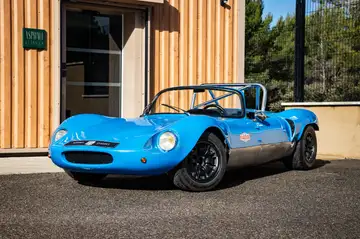
In the mid-1960s, at a time when French motorsport was still searching for its identity alongside Europe’s leading racing nations, a truly singular automobile was born: the Duchène Ford-Lotus. A unique prototype, it embodies an era when passion, ingenuity and creative freedom allowed a handful of individuals to design and build cars of remarkable technical sophistication, entirely outside any industrial framework.
At the origin of the project was Maurice Duchène, a talented racing driver and the head of a precision engineering company based in Bourgoin-Jallieu. Formerly associated with Matra, he set out to create his own uncompromising competition barchetta, enlisting the expertise of Jacques Hubert, a highly respected engineer from the René-Bonnet and later Matra design offices. Together, they drew inspiration from an abandoned Matra project—the 610 “Napoléon” coupé—to develop a lightweight, high-performance barchetta perfectly suited to hill climbs and rally competition.
The car is built around a sophisticated tubular chassis, reinforced by a central backbone, providing exceptional rigidity for an artisan-built machine. The rear mid-mounted 1.6-liter Ford Cortina–Lotus engine is fed by twin twin-choke carburetors and produces around 120 horsepower, with output rising to as much as 180 horsepower depending on the level of tuning. The rear suspension is derived directly from Matra prototypes, while Matra Formula 2 wheels, a Renault gearbox and numerous magnesium components reflect a level of design and finish far exceeding the usual standards of one-off constructions of the period.
Remarkably for a barchetta of this calibre, the Duchène Ford-Lotus was road-registered, enabling Maurice Duchène to compete not only in hill climbs but also in rally events. The car quickly distinguished itself with several top-level results, including two outright victories at the hill climbs of Le Gua and Crémieu. Actively campaigned throughout the late 1960s and early 1970s, it evolved over time in response to aerodynamic and regulatory changes, while retaining its original architecture.
After a period of abandonment, the car was rescued in the 1970s by Gilles Machette, who undertook a thorough and painstaking restoration. Following more than five years of work, the barchetta returned to competition between 1980 and 1990, taking part in numerous historic hill climbs and slalom events. Its unique character, strong performance and striking appearance made it a focal point in paddocks wherever it appeared.
The most recent restoration, carried out by its current owner, marks the third life of this extraordinary automobile. Executed with great respect for originality, it nevertheless incorporates discreet upgrades aimed at improving reliability and safety, including modern adjustable dampers, a complete overhaul of the suspension and braking systems, and adaptations suitable for road use and historic events.
Today, the Duchène Ford-Lotus represents far more than an isolated prototype. It stands as a rare testament to the golden age of French artisan-constructors, a missing link between René-Bonnet, the earliest Matra cars, and the spirit that would later give rise to France’s great competition prototypes.
A unique example with well-documented history and direct associations with key figures from Matra and French motorsport, it offers an exceptional opportunity for any collector seeking an authentic, high-performance automobile of genuine historical significance.
At the origin of the project was Maurice Duchène, a talented racing driver and the head of a precision engineering company based in Bourgoin-Jallieu. Formerly associated with Matra, he set out to create his own uncompromising competition barchetta, enlisting the expertise of Jacques Hubert, a highly respected engineer from the René-Bonnet and later Matra design offices. Together, they drew inspiration from an abandoned Matra project—the 610 “Napoléon” coupé—to develop a lightweight, high-performance barchetta perfectly suited to hill climbs and rally competition.
The car is built around a sophisticated tubular chassis, reinforced by a central backbone, providing exceptional rigidity for an artisan-built machine. The rear mid-mounted 1.6-liter Ford Cortina–Lotus engine is fed by twin twin-choke carburetors and produces around 120 horsepower, with output rising to as much as 180 horsepower depending on the level of tuning. The rear suspension is derived directly from Matra prototypes, while Matra Formula 2 wheels, a Renault gearbox and numerous magnesium components reflect a level of design and finish far exceeding the usual standards of one-off constructions of the period.
Remarkably for a barchetta of this calibre, the Duchène Ford-Lotus was road-registered, enabling Maurice Duchène to compete not only in hill climbs but also in rally events. The car quickly distinguished itself with several top-level results, including two outright victories at the hill climbs of Le Gua and Crémieu. Actively campaigned throughout the late 1960s and early 1970s, it evolved over time in response to aerodynamic and regulatory changes, while retaining its original architecture.
After a period of abandonment, the car was rescued in the 1970s by Gilles Machette, who undertook a thorough and painstaking restoration. Following more than five years of work, the barchetta returned to competition between 1980 and 1990, taking part in numerous historic hill climbs and slalom events. Its unique character, strong performance and striking appearance made it a focal point in paddocks wherever it appeared.
The most recent restoration, carried out by its current owner, marks the third life of this extraordinary automobile. Executed with great respect for originality, it nevertheless incorporates discreet upgrades aimed at improving reliability and safety, including modern adjustable dampers, a complete overhaul of the suspension and braking systems, and adaptations suitable for road use and historic events.
Today, the Duchène Ford-Lotus represents far more than an isolated prototype. It stands as a rare testament to the golden age of French artisan-constructors, a missing link between René-Bonnet, the earliest Matra cars, and the spirit that would later give rise to France’s great competition prototypes.
A unique example with well-documented history and direct associations with key figures from Matra and French motorsport, it offers an exceptional opportunity for any collector seeking an authentic, high-performance automobile of genuine historical significance.
Leasing
Verkäufer
HändlerASPHALT CLASSICS
(83% Weiterempfehlungen)
Anbieter auf AutoScout24 seit 2021KontaktTobias Scheffler
- MwSt. ausweisbar
- Herstellerangabe für Neufahrzeuge. Je nach Kilometerstand, Fahrverhalten, Batteriealter und Ladeverhalten kann die elektrische Reichweite bei Gebrauchtwagen deutlich abweichen.
Alternative Modelle
- Startseite
- Suche
- Sonstige
- Sonstige
- Sonstige Sonstige Duchene Ford-Lotus